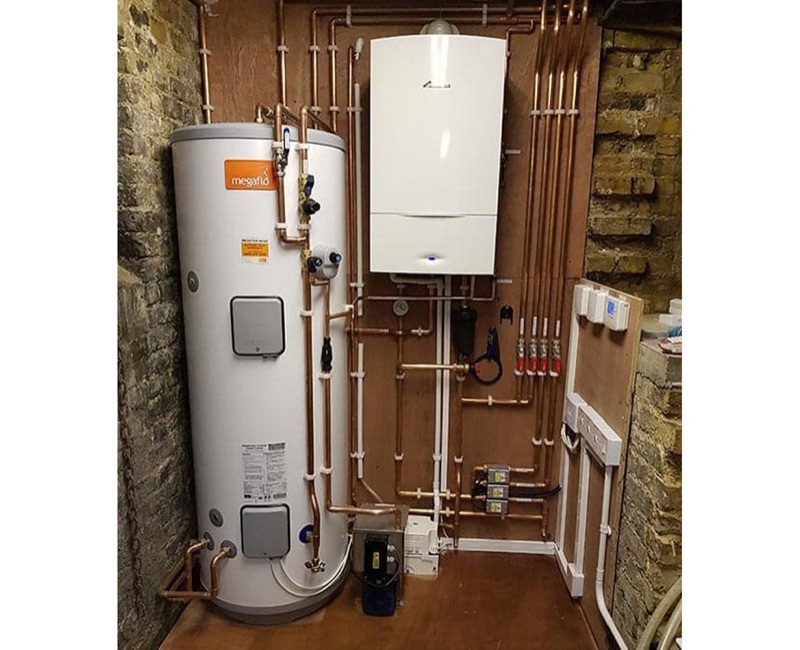
First: is water passing through it or escaping onto the floor?
Describe what you can see without touching the water: a drip falling through the open funnel, water escaping from a connection, or both. If you first noticed an outside pipe dripping, say so. A wider photograph showing the cylinder label and the pipe route is more useful than a close-up of one unknown valve. Do not remove boxing or covers to get it.
A tundish is a visible break in the discharge arrangement, often recognisable as a small open funnel. Water seen there is an observation about discharge; a wet floor around the cylinder is an observation about escaping water. They may occur together, but they should not be treated as interchangeable when reporting the problem. The distinction determines what needs describing before any part is discussed.
If you can see the equipment safely, take one photograph showing the whole arrangement and one showing the visible drip from a distance. Include the label if accessible. You do not need to follow a pipe behind a wall, move electrical equipment or remove an access panel to prove where it ends. Say explicitly when you cannot see the outlet.
A dark cupboard can make a small leak hard to describe. Use ordinary room lighting from a dry position; do not reach past hot pipework or wet electrics. If a photograph would require that, leave it. An imperfect description from a safe position is enough to begin the enquiry.
Can it wait for an appointment?
Steam, very hot discharge or suspected overheating needs urgent professional advice. If safe, switch off the cylinder heat sources at normal accessible controls. Keep clear, leave the water supply on and never obstruct the discharge. Do not touch it to judge temperature. Follow the exact model’s instructions and explain worsening discharge when arranging help; an existing appointment does not establish that waiting is safe.
Do not use the size of the drip as the only measure of urgency. Explain whether it has changed, whether there is water on surrounding surfaces and whether any other symptom appeared. A drip that was occasional when the appointment was made may now be continuous. The booking team needs that update, particularly when an occupied flat or neighbouring property could be affected.
If you rent, alert the landlord or managing agent to the active discharge rather than submitting it only as a request for annual maintenance. Where there is visible damage outside your own cupboard, tell the building manager as well. Keep clear of a ceiling that is sagging or dripping near electrical fittings.
Do not block the outlet to protect a wall or stop an annoying sound. That would conceal or obstruct the route that needs to remain available. Ask for immediate advice about the cylinder and any separate property damage. Gathering invoices and photographs can wait when there is a developing safety concern.
Source: Megaflo Eco Plus manufacturer manual: fault finding and warnings (PDF)
Why the tundish can drip: expansion, pressure control or valve leakage
The tundish makes discharge visible; it is not usually the component deciding when water is released. The investigation needs to establish which valve is feeding it and why. Vaillant's uniSTOR fault-finding material separates discharge from an expansion relief valve from temperature-and-pressure relief discharge. That distinction matters because an identical-looking drip at the funnel can be downstream of different faults.
Expansion accommodation, incoming pressure control and a relief valve that does not seal correctly are different areas to assess. Heating water needs provision for expansion. Depending on the cylinder, that provision may involve an internal air space or an external vessel. A pressure-control problem is different from lost expansion provision, and changing the tundish does not address either merely because water is visible there.
The timing is useful but not conclusive. Discharge seen during normal heating gives a different starting observation from a continuous drip; it does not identify a part without checks. Do not touch the water to classify its temperature or operate valves to create a test. Steam or suspected overheating takes priority over trying to identify the pattern.
Ask the competent person what test or observation distinguishes the proposed cause from the alternatives. If a valve is replaced, ask whether the underlying reason for discharge has been assessed as well. A short period with no drip is an outcome to record, but the original operating pattern should still guide the completion check.
| Observed condition | Useful distinction | Appropriate next step |
|---|---|---|
| Drip through the open funnel | Discharge is visible; cause still unknown | Identify supplying valve and cylinder arrangement professionally |
| Water around a pipe joint or on floor | External escape may be separate from discharge | Report both locations; assess joints and damage |
| Returns during ordinary heating | Timing may relate to the pressure cycle | Professional expansion/control assessment |
| Continues after applicable air-gap procedure | Manufacturer procedure has not resolved the symptom | Seek cylinder-competent assessment |
| Steam, very hot discharge or suspected overheating | Potential safety fault | Safe heat-source shutdown and urgent advice; never block discharge |
Sources: Caleffi: expansion vessels for heating and domestic water (PDF)
Source: Vaillant uniSTOR: heating controls and fault finding (model-specific manual)
You followed the cylinder label, but it is still dripping
A DIYnot resident traced an outside drip to the tundish and reported that following the label had not stopped it; the discussion gives no confirmed repair outcome. This is a useful point to stop and seek model-specific advice. Record what instruction you followed and whether the behaviour changed. Do not keep repeating an unfamiliar procedure because a video says it should take longer.
Keep the distinction between following the correct user instruction and improvising. If you used the instructions attached to the cylinder, record the model and the result. If you used an online video, tell the repairer which procedure it was rather than assuming it applied. There is no benefit in repeating the procedure solely to create another recording for the engineer.
Write down what happened afterwards: the drip stopped briefly, became less frequent, did not change or returned during the next normal heating period. These are useful outcomes even when you cannot name a component. Avoid reporting “the air gap is fixed” unless someone has actually established that; report the visible behaviour instead.
If an earlier owner or installer left instructions that do not match the present label, mention the mismatch. Parts or controls may have changed since those instructions were written. The next step is to identify the installed arrangement and obtain appropriate advice, not to combine pieces of several procedures until one seems to work.
Is an air-gap recharge always the answer?
No. Baxi publishes a homeowner air-gap procedure for applicable Megaflo cylinders and directs persistent dripping to a G3-qualified installer. Other arrangements use an external expansion vessel. Identify the exact model before using instructions: an air-gap procedure is not a general repair for every unvented cylinder. If you cannot identify the equipment, stop and ask. This guide does not walk you through operating safety valves.
The word Megaflo is not a complete model specification. Different cylinder ranges and installations should not be treated as identical because a household uses the same brand name for them. Look for the full product label and any installation record. A separate vessel near the cylinder is also worth including in an overview photograph, without deciding what adjustment it needs.
A homeowner recharge instruction is not a general invitation to open valve assemblies, alter pressures or dismantle components. Likewise, a professional maintenance task shown in an installation manual is not automatically a homeowner task. Check the audience and exact model before relying on a document.
For the booking conversation, the useful question is simple: does the attending person work on this particular type of unvented cylinder? If you cannot identify it, explain that in advance. A firm should be able to discuss what information it needs to allocate the enquiry without expecting you to dismantle the equipment or select a replacement safety valve yourself.
A plumber replaced a valve and the drip came back
Tell the repairer that the original symptom has returned and provide the date, invoice and part description if available. Note whether the drip is continuous or appears during normal heating, without restarting equipment with a suspected safety fault. Ask what the first assessment established and what the next visit will check. A DIYnot poster reported recurrence the morning after work and a planned return visit; the final cause remained unconfirmed in the thread.
A repeat visit is more productive when the earlier finding is available. Keep the invoice or job sheet and distinguish what the repairer diagnosed from what you understood at the time. “A valve was changed” leaves several questions open. A part description, date and account of the behaviour before and after the work provide a clearer starting point.
Ask whether the returning person needs the cylinder's ordinary operating history. If the drip usually appears during heating, say that; if it continues when you believe heating has stopped, say that too. Do not restart a suspect system to reproduce the symptom. Your normal-use observations can be enough to explain why a brief dry period did not satisfy you.
Discuss return charges before attendance. A callback, further diagnosis and replacement of a different component may have different terms. The question is what the next visit is intended to establish and how additional work will be authorised. A recurrence alone does not establish blame, warranty coverage or the next failed part.
Source: Public homeowner report: discharge returned after a visit (DIYnot, 2023; no confirmed final fix)
Book for cylinder work, not just a boiler check
Say “unvented cylinder” when enquiring, even if you normally call the whole cupboard the boiler. Ask whether the attending person is competent to work on that cylinder and whether you are booking a fault assessment or routine maintenance. Describe previous visits, including work on the boiler that did not address the cylinder. You should not have to identify a faulty part before asking for the right appointment.
Routine maintenance and an active fault enquiry should be described separately. If the cylinder is due a service and also dripping, mention both when arranging the appointment. Ask whether the allocated visit has time and scope for diagnosis, and whether any required parts or further work would need another agreement.
A boiler service record is not a complete account of cylinder maintenance. Store the records separately if the appointments covered different equipment. When more than one contractor has attended, a simple list of dates, equipment worked on and reported findings can prevent the next person assuming that another part of the system was already checked.
The appropriate person depends on the work required. An unvented cylinder needs relevant competence; any associated electrical or gas work also needs the correct expertise. Ask about the proposed scope rather than treating a broad job title as confirmation that every part of the installation is included. The purpose is to book the right assessment, not to assemble your own repair team based on guesses.
Does the whole cylinder need replacing?
Ask for the finding that supports replacement. A symptom report alone is not a comparison of a component repair with a new cylinder. Request the repair option, replacement scope and reason one is unsuitable before deciding. If there is immediate danger or active damage, obtain urgent advice first rather than delaying it to gather competing quotes.
Ask what has actually been assessed: the cylinder vessel, a connection, the expansion arrangement or another component. These are different findings and may lead to different work. A replacement recommendation should explain why a repair is unsuitable, rather than relying on the general statement that a cylinder is old or that repeated visits are frustrating.
Compare scopes as well as totals. A repair quotation and a replacement quotation may include different access work, electrical work, disposal, commissioning or making good. Ask which items apply to your installation and which are excluded. Also ask about the expected interruption to water use and how the property will be left if the work cannot be completed in one appointment.
Do not delay urgent make-safe advice while comparing planned replacement options. Immediate safety and the longer-term purchasing decision can be separate conversations. Once the immediate issue has been assessed, take the time to understand the finding and the choices. A clear written explanation is especially useful when a landlord, agent or insurer is involved in approving expenditure.
What should happen after a tundish repair?
Ask the attending person how the repair was checked and what you should expect during ordinary use. If the reported symptom was intermittent, a moment with no visible drip may not represent the full pattern you described. The completion note should make clear what was observed during the visit and what, if anything, remains to be confirmed.
Keep the same viewpoint for any later photograph so a change can be compared without moving equipment. If discharge returns, report when it happened and whether the heating controls were being used normally. Do not assume you should repeat a recharge or reset simply because one was used during the visit; ask for the relevant user instruction for the exact model.
Agree a contact route for recurrence and ask what information the repairer will need. That can save a second explanation through several people. If the issue includes new steam, suspected overheating or escaping water, follow the urgent advice at the top of this article rather than waiting for an ordinary callback. A written record should help communication, never delay a safety response.
What will a cylinder attendance cost?
For this fault, separate the cost of getting an engineer to the property from the work needed after assessment. AK Plumbing's callout charge is £60 for attendance; plumbing work is £160 per hour, with the hourly quote agreed before work. AK is not VAT-registered, so no VAT is added. The linked pricing page explains the published charging basis.
Before authorising work, ask about the likely diagnostic scope, parts and any further visit. The attendance fee is not a promise that diagnosis or repair is included. A replacement valve, work on associated controls and access to concealed pipework are different scopes; the person assessing the cylinder should explain which is proposed and why.
AK is based in North London, covers Greater London and operates a 24/7 phone line with emergency dispatch. Give the postcode and describe the active symptom so attendance can be discussed. This does not establish a guaranteed arrival time or that every part will be available during the first visit.