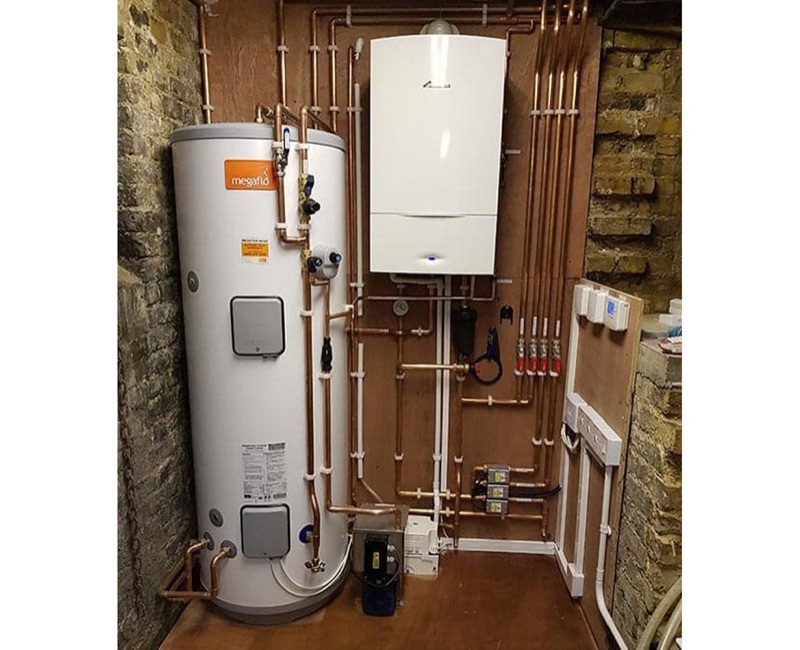
Stop if the problem includes overheating or electrical danger
Steam, unusually hot discharge or suspected overheating needs urgent advice: turn off the heat sources at safe normal controls if possible and keep clear. Do not block discharge pipes or bypass safety controls. For burning smells, repeated electrical tripping or water at electrical fittings, stop using the affected equipment and seek professional help. Do not open covers or keep resetting it to obtain another shower.
A loss of hot water on its own and a cylinder discharging very hot water are different situations. Lead with the danger when calling: describe steam, an unusual burning smell, an alarm or water near electrical equipment before explaining that a shower went cold. Do not wait to gather model numbers if approaching the cupboard is unsafe.
If you already have a visit booked, contact the booking team again when the symptoms change. An appointment made for cold water yesterday does not cover a new overheating concern today. Tell other household members which equipment should not be used, so someone does not turn it back on while trying to help. If the equipment was switched off on professional advice, record who gave that advice and leave restarting arrangements to the person assessing it. None of the observations below requires you to defeat a safety device or restore power to suspect equipment.
Source: Megaflo Eco Slimline manufacturer safety instructions (PDF)
How heat reaches the water: direct and indirect systems
An indirect cylinder needs a working heating chain: a demand for hot water, controls that respond to it, a heat source that runs and circulation that carries heat through the cylinder coil. Vaillant's uniSTOR manual describes the cylinder thermostat controlling a motorised valve. Resideo describes these valves as controlling water flow in heating systems. A break in that chain can leave the taps cold even when the boiler heats the radiators.
A direct cylinder uses electric immersion heating rather than relying on a boiler-fed coil. Here the relevant chain is electrical supply, the selected control, temperature control and the heating element. A safety cut-out is a protective part of the arrangement, not a normal switch to keep resetting. These categories explain why cold water does not identify one failed part.
For an indirect system, a professional can establish whether the hot-water demand reaches the controls and whether heat reaches the cylinder. For direct electric heating, the investigation follows the actual supply and control path. You can describe what the ordinary controls show; the electrical tests, valve assessment and internal checks belong to the competent person. Do not use a forum diagram as a wiring guide.
Sources: Resideo: what motorised heating valves control
Source: Vaillant uniSTOR: heating controls and fault finding (model-specific manual)
Match the behaviour before choosing a repair
If safe to observe, note which description fits: the hot tap has no flow; it flows but stays cold; it starts hot then runs cold; or it works only while the heating is on. Also say whether the problem affects one shower or every outlet. Record observations from ordinary use, not repeated tests that waste water or recreate a dangerous fault. If you do not know how the cylinder is heated, provide a label photograph and describe the controls you normally use.
Give the symptom a clear name. “Every hot tap flows normally but stays cold” points the conversation towards heating. “The cold taps work but nothing comes out of the hot taps” points towards supply or flow. “Only the shower is cold while the basin is hot” makes that outlet important. These are descriptions for sorting the enquiry, not remote diagnoses.
Also distinguish a new failure from an unfamiliar system. If you moved in yesterday, there may be no reliable baseline for normal operation. Find any handover instructions and ask the previous occupier, landlord or agent which controls were normally used. If you have lived there for years and the same routine suddenly stopped working, give the date of the change. Do not alter several programmes while trying to remember what used to work. Preserving the current settings in a photograph helps the attending person understand the starting point and avoids losing useful information.
| Symptom | Possible explanation — not a diagnosis | Safe observation | Professional investigation |
|---|---|---|---|
| All hot taps flow but stay cold | No heat demand or interrupted heating chain | Read normal programme and error display | Establish demand and heat-source operation |
| No hot-tap flow; cold taps work | Hot-water supply or flow restriction | Note affected outlets and recent water interruption | Assess the cylinder supply and flow path |
| Hot water only with radiators on | Hot-water demand/control route needs checking | Note hot-water-only behaviour already observed | Assess controls and heat delivery to the cylinder |
| Starts hot, then goes cold | Heating operation or available stored supply may not meet use | Note preceding programme and household use | Check normal heating before assessing capacity |
| One shower cold; another tap hot | An outlet-specific issue may be involved | Compare ordinary outlet behaviour | Assess the affected outlet and its supplies |
Normal user checks before arranging a repair
If there is no overheating, discharge concern or electrical danger, begin with the controls intended for everyday use. Check that the hot-water programme is enabled and that the displayed clock and day are correct. Look for an ordinary holiday, off or override mode. A heating programme and a hot-water programme can be separate: warm radiators do not demonstrate that the hot-water period was selected.
Next identify the labelled heat source you normally use. For electric heating, read the labelled supply or boost control against its user manual. Do not switch on unfamiliar equipment, open a cover or reset a tripping circuit. If a clearly identified normal control was accidentally left off, follow the manufacturer's user instructions; never use this as a reason to restart equipment that a professional told you to leave off.
Use observations from normal tap use to distinguish one affected outlet from all outlets. If the basin is hot but the shower is cold, keep that information separate from a whole-cylinder failure. If hot taps do not flow at all, use the flow branch below instead of waiting for a heating cycle.
Finally, read any accessible boiler error display and keep the exact code. Baxi's homeowner guidance includes power, controls and fault-code checks, but the correct manual for your appliance governs what a user may change. Stop at the point where a check requires tools, testing electrical connections or operating an unknown cylinder valve.
Hot water only works when the radiators are on
In a public DIYUK discussion, a new resident reported this exact pattern but received conflicting explanations; no final repair was confirmed. Treat it as a symptom to report, not proof of a failed valve. Note whether selecting hot water alone at the normal programmer gets any response, and provide the cylinder and boiler models. The cylinder’s heat demand and controls need checking before choosing a replacement part.
For this pattern, separate two ordinary observations: whether the programmer indicates a hot-water demand and whether the usual heat source responds. An illuminated symbol is worth reporting, but it does not prove that every part of the demand has reached the cylinder. A boiler that heats radiators is also not proof that its entire hot-water arrangement is working.
You do not need to identify a motorised valve or decide whether it has two or three ports. Describe the outcome in everyday language and leave component identification to the assessment. Useful details include whether the problem appeared after summer settings were selected, after controls were changed, or immediately after another repair. Keep those events as a timeline rather than assuming the most recent person caused the fault.
Ask for the hot-water-only operating mode to be assessed explicitly. If the visit takes place while the heating is already on, explain that this can conceal the very symptom you are reporting. Agree how that mode will be checked safely and what the result establishes.
Source: Public homeowner report: hot water only with heating (Reddit DIYUK; outcome unverified)
It heats, but one shower uses the hot water
Write down what happened before it ran cold: the heating programme, which labelled boost control you used, and other hot-water use. Include whether this is a recent change or how it has behaved since moving in. A public flat-owner report described short-lived hot water and an apparently ineffective boost, but did not establish the cause. A litre label or a shower duration alone is not enough to decide that the cylinder is undersized.
A useful shortage diary records demand as well as timing. Note when the normal heating programme last ran, whether someone had a bath or shower beforehand, and whether the water became gradually cooler or changed abruptly. Include a recent change to the shower, household routine or number of occupants. Approximate descriptions are acceptable; do not undertake prolonged flow measurements or waste a cylinder of water to produce a more impressive report.
The comparison that matters is like for like. A shortage after several users is different from a shortage on the first ordinary shower of the day. A problem that began after a replacement is different from a system that has always struggled at busy times. Those distinctions help an assessor decide what operation to verify before discussing capacity.
If a larger cylinder is proposed, ask how the recommendation accounts for the actual household routine and the existing heating arrangement. A larger vessel is a significant purchase; its suitability should be explained in relation to your needs, space and heat source, rather than inferred from one disappointing shower.
What the heating method changes
Direct cylinders use an internal heat source, typically immersion heating; indirect cylinders receive heat through a coil from another appliance. OSO separates no hot water, insufficient hot water and low temperature in its troubleshooting guidance. That distinction matters when describing a visit: checking an electric heater is not the same scope as tracing a boiler-fed hot-water demand. Use the manual for your model rather than assuming every cylinder has the same controls.
Look for the cylinder label rather than relying on a familiar nickname. People sometimes call an immersion heater, a hot-water cylinder and a boiler “the boiler”, although they describe different equipment. A photograph of the cylinder label and a separate photograph of the controls can prevent an enquiry being allocated as a boiler-only breakdown when the cylinder needs attention.
An indirect cylinder may also have electric backup heating. That does not mean the backup is commissioned, suitable to use during the present fault or controlled by the switch you have identified. Ask before treating another heat source as a workaround, especially if there is any discharge or overheating concern.
For a home served by communal heating, say that at the beginning. Ask the building manager whether other flats have reported a loss of hot water and whether access to shared equipment is required. Do not open a locked plant room or communal riser. The boundary between an individual flat's controls and a building supply needs establishing before private repair work is authorised.
No water from the hot tap is a different report
Tell the booking team if there is no flow at all rather than calling it cold water. Include whether cold taps still work and whether a building water interruption or recent plumbing work preceded it. Ariston’s fault table treats no water separately from a failure to heat it. Do not order an immersion element on the strength of “no hot water” alone.
Report the extent of the loss: one outlet, all hot outlets, or both hot and cold water throughout the home. Include a supply interruption, stop-tap work or building notice if there was one. If another resident has the same problem, relay that as their report rather than claiming the whole block is affected.
Do not try to restore flow by moving unfamiliar valves around an unvented cylinder. Different valves have different purposes, and a photograph cannot establish that a proposed valve is safe to operate. Normal taps and labelled user controls are the limit of this guide.
There is also a practical distinction between waiting for hot water to arrive at a distant outlet and water that never warms during normal use. Describe what you normally experience and what has changed. Do not keep a tap running indefinitely to see whether the cylinder recovers. The purpose of the description is to choose the right investigation, not to perform it yourself.
A new timer or control has not solved it
Keep the previous job record and describe what changed: did the indicator start working, did water heat once, and does the ordinary schedule now work? A tenant on DIYUK reported hot water continuing after a timer replacement despite an off setting; the thread did not confirm why. Before closing a repair enquiry, ask how the intended control operation has been checked. A working indicator by itself does not explain a recurring complaint.
For a repair that appears successful and then fails, preserve the sequence. “The timer was replaced on Tuesday; water was hot Wednesday morning; it was cold Thursday despite the same programme” is more informative than “it is broken again”. Add whether the original complaint was no heating, unpredictable heating or water running out. A replacement part can address one of those complaints without demonstrating that the others have been resolved.
Ask the repairer to distinguish a reported symptom from a tested finding. The job record should identify the work performed and any operating mode that could not be checked during attendance. If the concern is overnight operation, agree what you should observe the following morning and whom to contact if the water is still cold. This is a completion plan, not a request for you to check wiring.
A repair is complete only to the extent that the relevant operation has been checked. Ask whether the timer now creates the intended demand, whether the heat source responds and whether hot water becomes available afterwards. These are separate observations: a new display that lights up establishes less than a complete heating cycle. If an overnight mode cannot be demonstrated during daytime attendance, agree the safe normal-use follow-up rather than assuming the changed part proves every mode.
Source: Public tenant report: unexpected operation after timer replacement (Reddit DIYUK; cause unverified)
What to agree before the visit
Ask for the assessment charge and what it covers, who can approve parts, and how an unresolved fault or return visit will be handled. For rented or managed properties, identify who can authorise work and provide access. If replacement is proposed, ask what finding makes a repair unsuitable. The goal is a clear diagnosis and dependable hot water, with an explanation of the controls you will use afterwards.
Separate three decisions: paying for attendance, authorising diagnostic work and approving a repair. Ask what the initial appointment includes, how findings will be explained, and whether additional time or parts need your approval. For an intermittent problem, ask what happens if it does not occur during the visit. For a replacement recommendation, ask what was found that makes repair unsuitable and what further work the replacement would require.
AK Plumbing is based in North London and covers Greater London, with a 24/7 phone line and emergency dispatch. The callout fee is £60 for engineer attendance. Plumbing work is £160 per hour, with the hourly quote agreed before work. AK is not VAT-registered, so no VAT is added. Attendance does not include an assumed diagnosis or repair; confirm parts and the proposed scope separately. The pricing page is linked below.
When the work is complete, ask for the normal settings to be explained using your own controls. Knowing which programme heats the cylinder, which function is backup and how to report a repeat fault is more useful than leaving with a part name alone.